
A continued focus on low inflation will be important to keeping gold imports, IMF said.

Extreme poverty in India declined by 12.3 percentage points between 2011 and 2019, with rural areas doing better than urban centres, according to a working paper of the World Bank. India has not released a new household consumption survey since the NSS from 2011. By extension, the country has not released any official estimates of poverty and inequality for over a decade now, added the paper co-authored by economists Sutirtha Sinha Roy and Roy van der Weide.
In the previous week, total reserves dropped by $273.8 million to $312.382 billion.
Gold reserves rose by $588.8 million to $21.566 billion, as per the RBI data.

Keen to capitalise on the growing geopolitical support from African nations after the recently concluded G20 Summit, India is working with the African Union to hold the fourth India-Africa Forum Summit later this year in Kenya's Nairobi, sources said. Prime Minister Narendra Modi is expected to attend the mega meet along with as many as 50 African leaders, they added. First held in New Delhi in 2008, the India-Africa Forum Summit marked India's initial diplomatic efforts to seek a comprehensive partnership with the African bloc of nations as a whole, at a time when China had begun its own outreach.

Government is also will also enter into an agreement with Japan for a $50 billion swap.

The international community counts a lot on India's leadership of the G-20 at a time when the world is faced with the continued economic slowdown and social distress, the chief of the International Monetary Fund Kristalina Georgieva has said. "India, which is the president of G-20 countries, remains among the countries that perform better than the global average and by a good percentage," IMF managing director Kristalina Georgieva told reporters during a media roundtable on Thursday. India formally assumed the G20 (Group of 20) Presidency on December 1.

India's decision to ban the export of non-basmati white rice has pushed up global prices, prompting multilateral lending agencies, such as the International Monetary Fund (IMF), to call for a reconsideration of the move. Though nothing has been spelled out yet officially, sources said, the government might consider requests for government-to-government sale of non-basmati white rice, especially to West African nations where India is a major supplier. Also, traders and exporters of specialty regional rice varieties like sona masuri or gobindo bhog feel that they have been short-changed.

Gita Gopinath, the IMF's Indian-American chief economist has been promoted as its First Deputy Managing Director recognising her exceptional intellectual leadership in helping the global economy and the Fund to navigate the "twists and turns" of the "worst economic crisis of our lives". Gopinath would replace Geoffrey Okamoto who plans to leave the International Monetary Fund early next year, Kristalina Georgieva, IMF's managing director announced on Thursday. Gopinath, who was scheduled to return to her academic position at Harvard University in January 2022, has decided to stay, she said. Gopinath, 49, has served as the first female chief economist of the Washington-based global lender for three years.

The IMF lowered India's economic growth estimate for the current fiscal to 4.8 per cent and listed the country's much lower-than-expected GDP numbers as the single biggest drag on its global growth forecast for two years.

Trump has repeatedly blamed China for the coronavirus pandemic which originated in the central Chinese city of Wuhan in December last year and accused Beijing of suppressing the details of the contagion.

India's exchange reserves rose by a robust $2.03 billion to $277.38 billion in the week ended September 20 on a healthy increase in the core currency assets, Reserve Bank said.

The anti-government protests near the presidential secretariat in Colombo resumed on Sunday after the authorities lifted the nation-wide curfew to celebrate the Vesak -- what we call Buddha Purnima in India -- festival.

India's foreign exchange reserves strengthened by $544.7 million to $275.35 billion on a healthy increase in the core currency assets in the week ended September 13.

India's foreign exchange reserves declined by a huge $2.23 billion to $275.49 billion on a sharp dip in the foreign currency assets, the Reserve Bank said on Friday.

The country's foreign exchange reserves rose by $1.434 billion in the week ended August 9, after dropping by $2.99 billion previous week, the Reserve Bank of India said.

Notably, Ukrainian forces disabling bridges across the Dnipro river and attacking Russian supply lines made it very difficult for Russia to defend the occupied territory.

Bhalla will succeed former RBI deputy governor Subir Gokarn, who died in the US on July 30 after a brief illness.

The rupee resumed lower at 64.20 per dollar.
Foreign currency assets, a key component rose $1.6 bn to $304.9 bn.

The rise in reserves was $2.12 billion.

Union Minister Nirmala Sitharaman on Thursday said speaking Hindi gives her 'shivers' and she speaks the language with hesitation.

The three-year tenure of Raghuram Rajan saw the RBI adding a net of $92 billion to the kitty.

India's external debt rose by 8.2 per cent year-on-year to $620.7 billion as of March 2022, which according to the finance ministry is sustainable. While 53.2 per cent of it was denominated in the US dollar, Indian rupee-denominated debt, estimated at 31.2 per cent, was the second largest, as per the status report on India's external debt released by the ministry. "India's external debt continues to be sustainable and prudently managed. As of end-March 2022, it stood at $620.7 billion, growing by 8.2 per cent over the level a year ago.

Foreign currency assets, a major component of the overall reserves, declined by $3.208 billion to $395.276 billion.
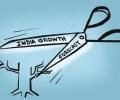
The International Monetary Fund (IMF) on Tuesday cut its projection of India's economic growth in 2022 to 6.8 per cent, as it joins other global agencies that have trimmed forecasts. The IMF had in July projected a gross domestic product (GDP) growth of 7.4 per cent for India in the fiscal year that started in April 2022. Even that forecast was lower than 8.2 per cent projected in January this year. India had grown at 8.7 per cent in 2021-22 fiscal (April 2021 to March 2022).

India will grow at around 7.4 per cent in 2022-23 and continue at the same pace in the next year as well, Union Finance Minister Nirmala Sitharaman said on Friday. Sitharaman said there are risks on the external front and this is not the right time to throw caution to the wind, and also assured exporters of all the necessary support from the government as they face the headwinds. Speaking at the FE Best Bank Awards event here, Sitharaman said global agencies like IMF and the World Bank have taken cognisance of the strengths of the Indian economy by saying that it will be among the fastest growing ones in the next two years.

The FATF continuing Pakistan in the 'Grey' list means its downgrading by IMF, World Bank, ADB, EU and also a reduction in risk rating by Moody's, S&P and Fitch.

Enforcement Directorate officials said on Friday they are probing a 'complex network' of agents and facilitators in India, Canada and the US who help Indians illegally enter the US via 'bogus' admissions in Canadian colleges.
IMF's Chief Economist Gita Gopinath will leave her job in January next year and return to the prestigious Harvard University, according to the global financial institution.

13 eminent economists, including former RBI governor Raghuram Rajan and current International Monetary Fund Chief Economist Gita Gopinath, in a report have asked the political establishment not to resort to populist tricks.

The International Monetary Fund (IMF) has said India and China will account for half of the global economic growth in 2023, as the multilateral agency retained its growth forecast for Asia's third-largest economy for 2023-24 (FY24). "India remains a bright spot. Together with China, it will account for half of global growth this year, versus just a tenth for the US and euro area combined," the IMF said in its latest update to the biannual World Economic Outlook. Growth in India is set to decline from 6.8 per cent in 2022 (FY23) to 6.1 per cent in 2023 (FY24) before picking up to 6.8 per cent in 2024 (FY25), the global lender said while citing "resilient domestic demand despite external headwinds".

The International Monetary Fund (IMF) on Tuesday said it is expecting some slowdown in the Indian economy next fiscal year and projected the growth to 6.1 per cent from 6.8 per cent during the current fiscal ending March 31. The IMF on Tuesday released the January update of its World Economic Outlook, according to which the global growth is projected to fall from an estimated 3.4 per cent in 2022 to 2.9 per cent in 2023, then rise to 3.1 per cent in 2024. "Our growth projections actually for India are unchanged from our October Outlook.

Ahead of the 2023-24 Union Budget, the thinking at the top level of the central government is clear: Gross domestic product (GDP) growth of 6-6.5 per cent is a comfortable enough target for FY24 and the focus should be on fiscal consolidation to ensure that the sovereign cost of borrowing does not become prohibitively expensive in a high-interest rate environment, according to people in the know. Those aware of deliberations between the Prime Minister's Office (PMO) and the Ministry of Finance said while the Budget would look to strike a balance between infrastructure investment and welfare schemes, it is unlikely to be populist, though it will be the last full-year Budget before the 2024 Lok Sabha election. Incidentally, 6-6.5 per cent GDP growth is what the upcoming 2022-23 Economic Survey is expected to project for FY24.

Prime Minister Sharif will be visiting Beijing with a high-powered delegation from November 1, 2022, where minutes of the joint coordination committee meeting will be signed.

'We are cautious only on sub-sectors that have seen massive melt-up during the past six months.'

The central government is likely to further consolidate its fiscal deficit by 50 basis points (bps) to 5.9 per cent in FY24 from 6.4 per cent in FY23, according to a recent report released by Goldman Sachs on Tuesday. In the current fiscal year, there is going to be an upside of 0.5 per cent on the receipts side due to higher nominal GDP growth, and higher tax buoyancy because of the formalisation, the report said. The upside to expenditure is mainly going to come from incremental subsidies (0.8 per cent of GDP), in both food and fertilizer, it said. The upcoming pre-election Budget will carry forward the trend of the increased capital expenditure seen in recent years.

The Pakistani PM is now scheduled to travel to Malaysia next week and to China on November 3 to seek financial assistance from the two friendly countries.

International Monetary Fund (IMF) chief economist Gita Gopinath has made a strong case for regulating cryptocurrencies, saying it will always be a challenge to ban them as they operate from offshore exchanges. Gopinath also suggested a global policy and co-ordinated action for regulating cryptocurrencies. "I think cryptocurrencies are a particular challenge for emerging markets. "It seems to be more attractive to adopt cryptocurrencies and assets in emerging economies than in advanced economies," she said while addressing an event organised by the National Council of Applied Economic Research (NCAER) on Wednesday.

The Left party had favoured spending six and three per cent of GDP on education and health care sectors.
